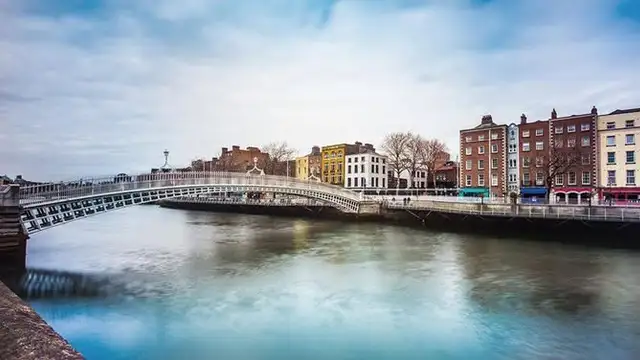
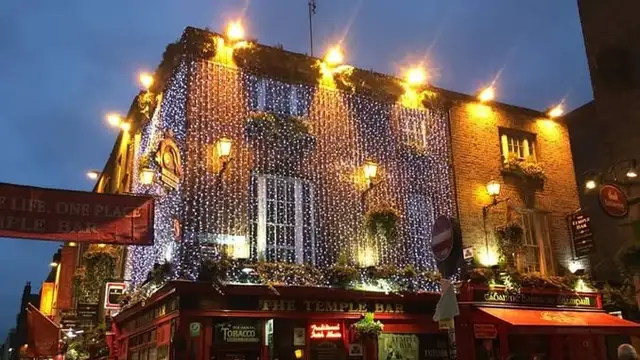
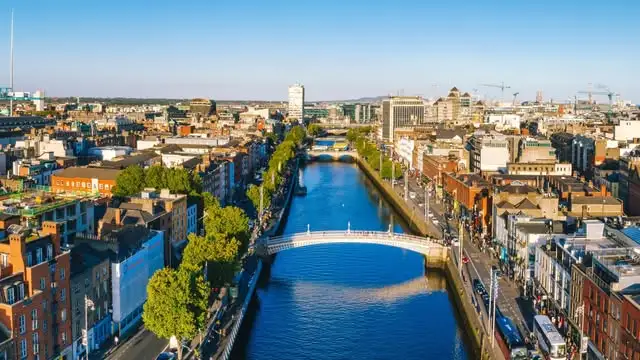
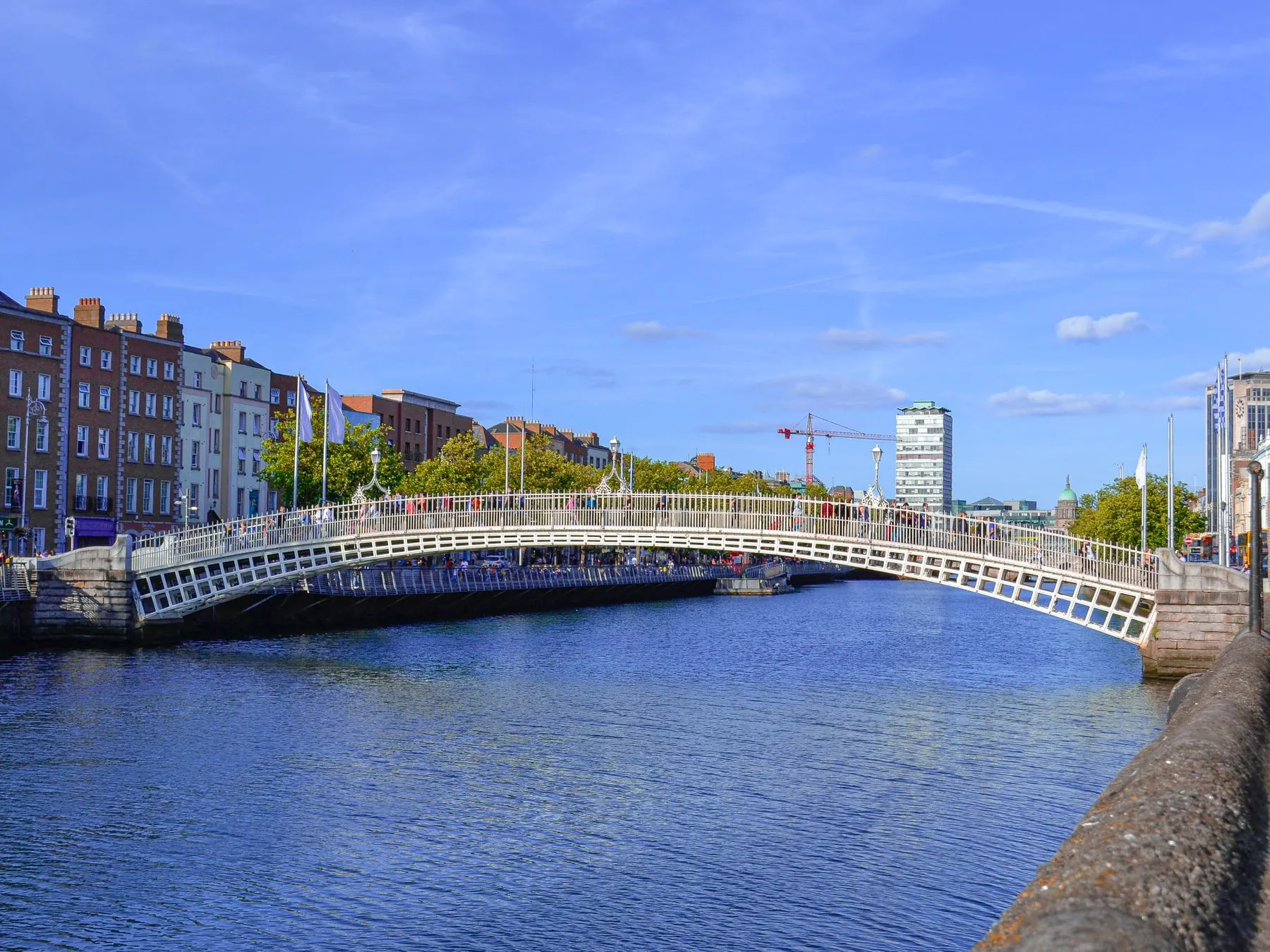
Dublin is a human-sized, English-speaking, European capital: no visa for a French family, the euro in your wallet and the sea twenty minutes away by DART. Between the Lycée français international Samuel-Beckett, free Irish schools, ticketless national museums and huge parks, the city is gentle on children, as long as you understand its health system and its housing market. Here are the landmarks to get started, checked at the source.
Currency
Euro (€)
Language
English (Irish is the first official language)
Time vs Paris
1h behind
Emergencies
112 or 999
FIAFE network
The Accueil for French-speaking families
In each city, a volunteer-run association from the FIAFE network welcomes, informs and helps French-speaking families settling in.
Dublin Accueil
Since 1994
Since 1994, Dublin Accueil has brought together French, French-speaking and francophile residents to make Dublin life easier: cultural visits, cooking workshops, coffee meetups, a book club, hikes, themed evenings and a private members' directory, all run by volunteer members who pass on their knowledge of Ireland year after year.
Where to meet them
No fixed drop-in: a monthly welcome coffee at a member's home for newcomers, a hike every Friday morning around Dublin and a weekly WhatsApp reminder of activities; first contact by email or through the website.
Back-to-school drinks in October and board game evenings
Other support networks
Two large national networks also support the French abroad, each with its local chapter.
UFE
UFE Irlande
The Irish chapter of the Union des Français de l'Étranger (network founded in 1927): welcome, mutual aid and defence of the interests of the French in Ireland with public authorities; contact through the national website form or by email.
The Irish section of Français du monde - ADFE defends the rights of the French in Ireland and publishes practical guides on its website (healthcare and the HSE, housing, finding a job), with an online book club and quiz nights.
The local French chamber of commerce (CCI France International network) is a real asset for work: networking, job offers and help to restart a career or start a business locally.
CCI France International
France Ireland Chamber of Commerce (CCI France Irlande)
The Franco-Irish chamber of commerce, founded in 1978, brings together more than 170 companies in Dublin and across Ireland: around forty events a year, sector working groups, help setting up and the LeBooster Dublin workspace, a valuable network for a spouse looking for a job or wanting to start a business.
To follow local life in French: news, what's on, good addresses and, often, a directory of French-speaking professionals.
lepetitjournal.com Dublin
MediaIn French
The Irish edition of the online daily for French expatriates: news, community, events, and Living in Ireland sections (housing, education, health, settling in, jobs) with a free newsletter.
The expat directory for Ireland: useful addresses and French-speaking professionals who list themselves; complement it with the consulate's list for health practitioners.
The French-language online guide to Ireland: places to visit, itineraries, festivals, food, practical tips and a newsletter, invaluable for planning weekend outings and family visits.
Before you even land in Dublin, Facebook groups are the best shortcut: ask your questions, find a flat, a nanny, a second-hand stroller, and often your first friends.
Public In English
RENT in Dublin, Roommates, Flatshares, Flatmates, Roomster ...
This is a multinational group created for Expats working and living in Dublin. (So please, English is the only language accepted here, for both posts and...
Les Frenchy à Dublin (stages, jobs, logements et infos utiles)
29,100 members
Bonjour les Frenchy!
Vous pouvez poster ici toutes vos questions, vos annonces, vos évènements qui concernent notre belle ville de Dublin.
Ce groupe sera...
Hello les Frenchies!
Je m'appel Coraline et j'ai cree ce groupe pour venir en aide a tous les Francais expatries a Dublin et en Ireland. C’est un groupe...
Bienvenue sur le groupe des Français à Dublin.
✅ Sur ce groupe vous pouvez dialoguer et vous conseiller, dans le respect des autres et la bonne humeur....
DUBLIN EXPATS is a group for people who live in, are visiting or just plain like Dublin. Everyone can promote their business, career opportunity, seeking...
Compiled from Facebook's public search, links checked in July 2026. Group sizes change all the time.
AEFE network
Accredited French schools
Schools accredited by the French Ministry of Education follow the French curriculum: your child can continue their schooling seamlessly, abroad and back in France.
Source: official AEFE directory, verified June 2026. aefe.gouv.fr
Tutoring and private lessons
To support your children's schooling across two systems, two solutions designed for expat families.
Axiom Academic
Private lessons and tutoring for expat families: French curriculum, IB and British curriculum, at home or online, with teachers who know the schools in your city.
Two systems live side by side: Irish schools, free and open from age 4 or 5 in junior infants, and a single accredited French school, the Lycée français international Samuel-Beckett, from nursery to final year on two campuses in south Dublin.
Good to know
State schools (national schools) are free, with a voluntary contribution; you apply directly to each school, which publishes its admissions policy, with no catchment area.
School is compulsory from 6 to 16, but most children start junior infants at 4 or 5, in September; applications for the following year open on 1 October.
The AEFE-accredited LFI Samuel-Beckett takes nursery children with no French required at Foxrock and prepares both the brevet and the Junior Certificate at secondary level on the Clonskeagh Eurocampus; 30 to 40 places a year, applications from 1 October.
The Irish school year starts in the week of 1 September and ends in late June for primary; the October, Christmas, February and Easter breaks are set nationally. Uniforms are the norm.
French-speaking community
Dublin's French community is young, often here for tech or pharma, and concentrated south of the Liffey between Ranelagh, Blackrock and Foxrock. Dublin Accueil, the Alliance française and FLAM Dublin are its rallying points.
Good to know
Dublin Accueil, part of the FIAFE network, runs a monthly welcome coffee, a Friday hike and outings all year round.
The Alliance française de Dublin, on Kildare Street, houses the largest French-language library in Ireland and classes for ages 2 to 18.
FLAM Dublin and French Minded run French-language workshops for children in Irish schools, from 0 to 16.
Facebook groups of French residents in Ireland are very active, from housing to nanny tips; lepetitjournal.com Dublin shares the community's calendar.
A place has closed, something has changed?
The arrival reflex
The apps to download when you land
Drop your bags, download these and you're set: the apps everyone in Dublin uses to get around, get things delivered and organise daily life.
Getting around
TFI Live
Ireland's official transport app: live Dublin Bus, Luas and DART times at your stop.
What mums ask when they arrive in Dublin, in short, sourced answers.
Irish school or Lycée français: where do we start?
Children start Irish school (national school) at 4 or 5 in junior infants, state schools are free and you apply directly to each school, which publishes its admissions policy. The AEFE-accredited Lycée français international Samuel-Beckett charges fees, from nursery to final year, with 30 to 40 places a year: applications from 1 October for the following September. Our Schools and School fees pages detail both systems: /en/cities/dublin/school-fees/.
Source ↗How do I get a place in an Irish state school?
There is no catchment area: each school publishes an admissions notice and an admissions policy on its website, and applications for the following September open on 1 October. Almost all schools have a patron (most often Catholic, or multi-denominational like Educate Together), which affects the criteria when oversubscribed. Visit, apply to several schools and ask for a mid-year place as soon as you have an address.
Source ↗Do we need health insurance for the children?
Not necessarily: as soon as you live in Ireland, public hospitals are free and every child under 8 is entitled to a free GP visit card, with no means test. Adults pay for GP visits unless they hold a medical card, and specialist waiting times push many families towards private insurance, often provided by the employer. It is all explained on our Health page: /en/cities/dublin/health/.
Source ↗How do I find a paediatrician, ideally French-speaking?
In Ireland there is no community paediatrician: the GP follows children and refers them to hospital, with the public health nurse for the little ones' check-ups. The embassy publishes a list of French-speaking practitioners (GPs, a dentist, a speech therapist, psychologists) with no paediatrician; we list the Dublin ones on our Health page: /en/cities/dublin/health/.
Source ↗Which number do I call if my child is ill at night?
112 or 999 only for a life-threatening emergency. For everything else, your area's GP out-of-hours service answers in the evening, at night and at weekends, sees the child and directs you if needed to one of the Children's Health Ireland emergency departments (Crumlin, Temple Street, Tallaght), open 24/7 up to age 16. Without a GP letter, the emergency visit is charged.
Source ↗Which neighbourhood should we settle in with children?
French families follow the two campuses of the Lycée français: Foxrock, Cabinteely and Blackrock around the primary school, Clonskeagh, Donnybrook and Ranelagh around the secondary Eurocampus, and more broadly the south coast by DART down to Dún Laoghaire. Even-numbered postcodes south of the Liffey are the most sought after and the dearest; the north coast (Clontarf, Raheny, Malahide) offers more space. Our Settling in page reviews the neighbourhoods: /en/cities/dublin/settling-in/.
In order: an address, then a PPS number application for each family member on MyWelfare (ID, proof of address, reason), a bank account, choosing a GP and registering under-8s for their free card, registering the job on Revenue's myAccount to avoid emergency tax, a Leap Card, and the consulate's French register, online and free. Details on /en/cities/dublin/settling-in/.
Source ↗Do my children pay for the bus, Luas and DART?
Not until age 9: under-5s travel free without a card, and the Child Leap Card 5-8 gives free travel until the 9th birthday across the whole Transport for Ireland network. From 9 to 18, the Child Leap Card (5-15 then 16-18, with photo) unlocks reduced child fares. For you, the Leap Card with its 90 Minute fare and daily caps is far cheaper than single tickets.
Source ↗Crèche, nanny, au pair: how do you get a little one looked after?
Crèche fees are one of the heaviest lines in an Irish budget, but two schemes lighten the bill: ECCE preschool, free for 3 hours a day over 38 weeks from age 2 years and 8 months, and the National Childcare Scheme, an hourly subsidy paid to the crèche, universal or income-assessed, from 6 months to 15 years. Au pairs and childminders complete the picture; the embassy publishes a guide to au pair status in Ireland.
Source ↗My child does not speak English: how will they cope at Irish school?
Very well, and faster than you: Irish schools have language support teachers for newly arrived children. The real challenge then becomes keeping French: FLAM Dublin and French Minded workshops, Alliance française classes and camps at every holiday, the médiathèque and Mass in French. Our addresses are on /en/cities/dublin/family-outings/.
Source ↗Is Dublin really that expensive for a family?
Yes for two items: housing, which the embassy describes as dearer than Paris, and childcare for little ones. The rest balances out: free state schools with textbooks provided, free national museums, free transport until age 9, free GP before 8 and public hospitals with no bill. Groceries and restaurants remain dearer than in France. Our Settling in page details the budget line by line: /en/cities/dublin/settling-in/.
Source ↗Where can I meet other French-speaking mums?
Dublin Accueil runs a monthly welcome coffee at a member's home, a Friday morning hike, mum-and-baby meetups and back-to-school drinks in October. FLAM workshops, the Alliance française children's classes, the Lycée français school gates and Facebook groups of French parents in Ireland do the rest; lepetitjournal.com Dublin lists the community's events.
The MumExpat assistantSchools, health, paperwork, outings, city by city
The assistant answers from the site's content and cites its pages; it can be wrong, check the page it cites. It replaces neither a doctor nor the consulate.
Hello. Tell me your city and your question: I answer with the guide's verified landmarks and point you to the page to read.
Your privacy matters
Today MumExpat only uses essential cookies (anti-spam and security). If you accept, we may also enable audience measurement to improve the site. Learn more


 City guide